Wednesday, October 10, 2012

Top 5 Places to go for Archaeology


 Archaeology Sites

Looking, for some good sights to vacation to? Wanting to learn some new things about Archaeology? Here are the top five places to go in North America if you answered yes to all of these.


Coming in at number 5 is the beautiful Teotihuacan, the oldest on the list making ti very rich with History. Teotihuacan is located Northeast of Mexico City. Teotihuacan was once the largest urban areas in North America, and even could have competed against Rome in 500 B.C. There are many beautiful sites here some specific sights that stand out more then others are Calzada de los Muertos (Avenue of the Dead), Pyramid of the Sun (Currently the worlds third largest pyramid), and the pyramid of the moon.

Considered by many who live in the country Mexico's most breathtaking archaeological site, number four is the awe striking Palenque, located in the state of Chiapas. Here they have beautiful architecture decorating the buildings and a few very important Mayan temples. There are still many archaeologist excavating this site too.

As we head over to the U.S. you will find the Mesa Verde national park neat Cortez Colorado. Number three on our list has more than 4,000 known archaeological sites, among them of which some 600-plus cliff dwellings of the ancestral Pueblo people. Also at this extravagant place you can find the beautiful Sun Temple.

One of the most dignified and highly notable archaeological remains in North America can be discovered in New Mexico’s Chaco Canyon. Number two on our list is a scenic place surrounded by mountains and mesas, filled with quiet Chacoan sites, ancient roads, rock art, and prehistoric stairways.


A group of  people you might have heard of Called the Icelandic Vikings landed in what is today known as Newfoundland, Canada. It is on this island where the oldest known European settlement in North America is located. This area, Founded around A.D. 1000, called L’Anse Aux Meadows showed a small community, including houses, several workshops and a small forge, where iron was smelted in the New World for the first time.
 
Wanting more information? Try this Amazing site where I based my information from: http://www.askmen.com/top_10/entertainment/top-10-archaeology-sites-in-north-america.html

The Linen Cloth

Current Scans showed from an Egyptian mummy, which, was discovered in the nineteenth century, showed that a young male from a horrible case of abscesses (a swollen area) and  cavities inside of his teeth. Scientists, although can not tell exactly what his age of death was, estimated it either to be in his earl twenty or thirty's. Less advanced showed that there was a large mass inside of his moth, but with current technology we now know that it was in fact a linen cloth in between two of his molars. this linen cloth was placed as a protective barrier between the molars, and was probably soaked with a pain killer device then put into the moth for relief. You can tell that technology has come a very long way from what it has had before, now we do not have to rely on those methods as they did back then.

For more information please go to this website for more informationhttp://www.archaeology.org/news/
                                                  

Monday, September 3, 2012

Top Schools for Archaeology

In the UK the top school for archaeology, is currently Cambridge University placing in first and Oxford in second.   The top school in the US currently for classic archaeology is Bryn Mawr College as first and with Cornell University placing in second.

If you are looking for a good University for Archaeology, I suggest for you to check out Cambridge University, because it is a very well known school, being ranked one of the highest university's overall in the world. Though it will be difficult to get into the school considering it being a prestigious school, and quite pricy, it will surely further your career options in Archaeology if you graduate from it.

Congratulations to the schools for placing in first and second, and may your archaeology academy's progress further!


[Frontispiece]


If you would like to check out more schools or get more information please check out the website http://www.ancientdigger.com/2009/07/top-archaeologyanthropology-schools.html

Saturday, August 25, 2012

London’s volcanic winter

Large grave sites were much needed in the Medieval world, bit it was very difficult trying to find  out the purposes of any given site. A man named Don Walker that a group in Spitalfields cemetery can be connected to a massive volcanic eruption.


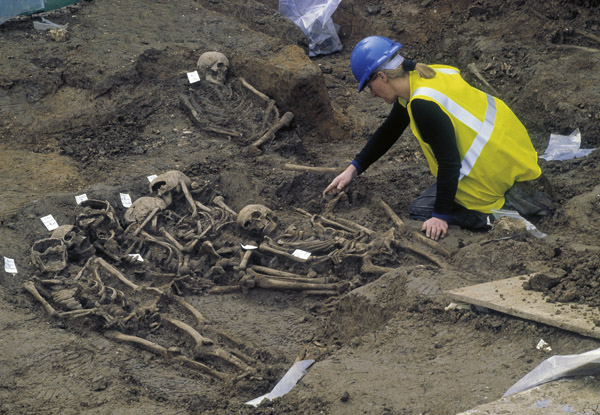
The Medieval cemetery at Spitalfields is one of the largest excavated graveyards in the world today. Hard work by MOLA between 1998 and 2001 unearthed a staggering 10,516 burials of this number 5.300 have been studied with much detail.  Some of the places  of the cemetery destroyed during the construction of Spitalfields market, it is probably around 18,000 people were once buried there. Also there was an unmatched corpus of skeletal material for the period, a programme of Bayesian radiocarbon dating by Alex Bayliss and Jane Sidell has provided a number for the Medieval cemetery. Obtaining much detailed phasing for a site type that is noticed for hard being to date proved useful when it came to understanding how the cemetery population met their fate. It also allowed change within that population to be studied over time.
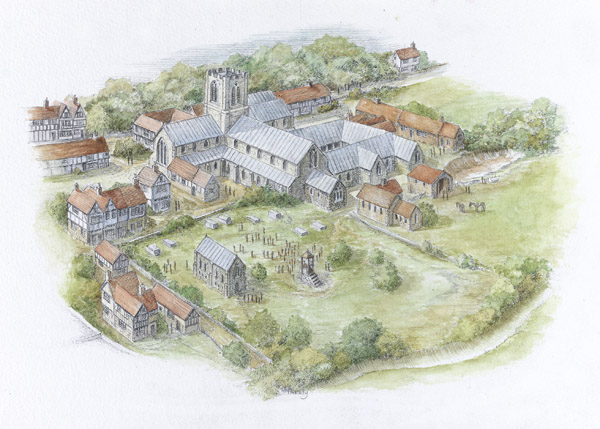
Spitalfields cemetery was closely associated with the priory and hospital of St Mary without Bishopsgate, later known as St Mary Spital.

The first burials in the cemetery, however, seem to have been a response to pressures of a different kind. Radiocarbon dated to about 1120, the earliest bodies pre-date the priory by a good 70 years. The corpses were dumped in open pits. Such type of burial is much different from any known religious house evokes an emergency situation in which large numbers of bodies needed to be disposed of rapidly. If so, it was certainly not the last time that a disaster got held of the suspension of normal burial practices at Spitalfields.
The foundation of St Mary Spital brought the construction of a church at the north-west corner of the cemetery, while the other buildings were nearby. Though the most of those laid to rest in the graveyard were placed in individual grave shafts in neat rows, excavations revealed a group of 140 large pits clustered along the south and east margins of the cemetery.
Dug as far from the main buildings as the cemetery allowed, each pit had between 8 and 40 bodies. A sure sign that the death rate had once again overdid existing burial measures, wishing to keep these mass graves away from inhabited areas underscores a very real fear of the dangers the bodies could pose for the living. In London, the natural reaction to discovering such mass burials is to think them as plague pits from the 1348 Black Death.

Radiocarbon analysis proved false to this idea. Consistently returning dates around the mid 13th century for both sets of burials, this placed them almost a century too early for the Black Death. It was this hard number information that made Don Walker and Amy Gray Jones of the University of Chester to make a connection between the later group of mass burials and the widespread fatalities seemingly brought on by climatic change in the wake of the 1258 eruption.
The earlier pits would fit reports of a famine in 1252. The difference in rigor appears to have been marked – while the first mass graves typically contain between 8 and 20 bodies, the second group were larger and held 20-40, making that up to twice as many corpses needed disposing of at any given moment. Between them the two pit groups contained 2,323 people from the studied sample, accounting for over half the analysed bodies buried in the cemetery during this period.

If you want more information on this you can go to http://www.archaeology.co.uk/articles/features/londons-volcanic-winter.htm  


Introduction


Hello! My name is Amanda and I have chosen to start my own blog for a project that I am doing for my Journalism class. This blog will be mainly focusing on Archaeology and the current events of it. I plan on giving the latest news of what is happening today in Archaeology and I every now and then I might choose to put my opinion on a subject. I will do my best with this blog and I hope you enjoy it! Thank you!